It is a great pleasure and honor to speak today to the JIM participants. My subject is the ‘Technology as an expressive extension of my artistic sensibility’. I do not see technology only as a means, but as central to my thinking and the design of my pieces.
Curiosity is something that interests me in all kinds of activities, in education, and in interaction with other people. I want to create situations where someone can develop an inquiring mind and be open to the world. I myself had the chance to travel a lot and to get introduced to many different forms of creativity. I studied drama, music, painting, photography, ceramics and all this is somehow connected with technology and with computer programming.
I will divide this presentation into four parts. The first is about education and creation. Then, I’ll talk about the question of gesture and about a few ideas on multimedia and installations. I’ll finish on iOS devices and some opportunities that I have explored in this area.
education - creation
My journey began with a dual education in music and theater, and I see my creations like activities in a network of influences.
As my parents are musicians, I had the chance to learn the piano very young and I joined a theatre group at the age of 13. But there were many other factors that had a strong influence on my education.
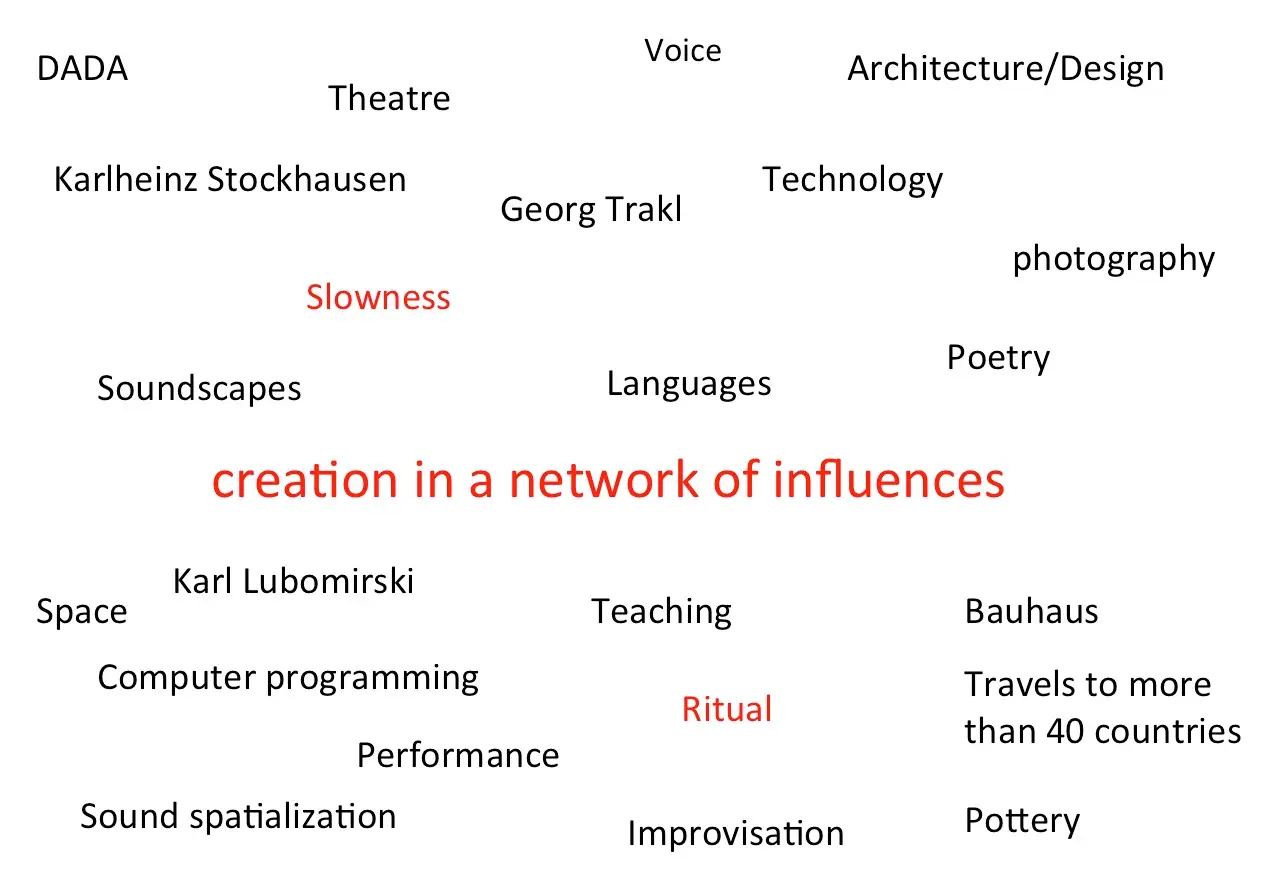
Being born in Weimar, a very cultural city with the Bauhaus, with classical music, with Bach, Liszt etc.; also to have begun to improvise very young. When I was 15, I joined a group that I will discuss later some more.
Here are some questions:
- Who I am as an artist?
- Is what I do genuine?
- How do I digest and rework artistic influences that I admire?
- And by doing so, how I do not become a clone, but how do I find my own voice?
Another issue that is quite central to my thinking:
- How much should I be an expert in a certain field to present my results to the audience?
Here are two words that are very present: integration and confusion. How can technology be integrated into my work and at the same time how can it generate a situation of confusion and surprise?
I will demonstrate how the use of computers - and technology generally - has changed my compositional thinking.
If we imagine the creative process schematically, we could say that we develop an idea, we realize it and obtain a result.
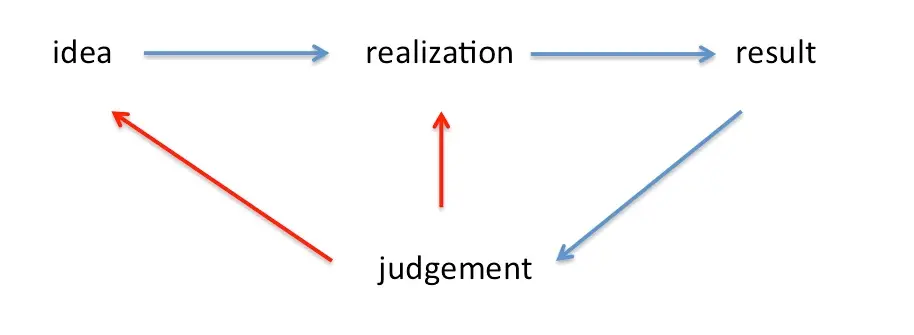
I take my pen; for example, I write some notes on paper and I observe it. My judgment will point to both the realization and to the idea. I will go into a recursive loop, which gradually changes the idea and the way, how I realize the idea to improve the result.
When technology enters the game, it gets a little more complicated because there is one more step necessary: formalization.
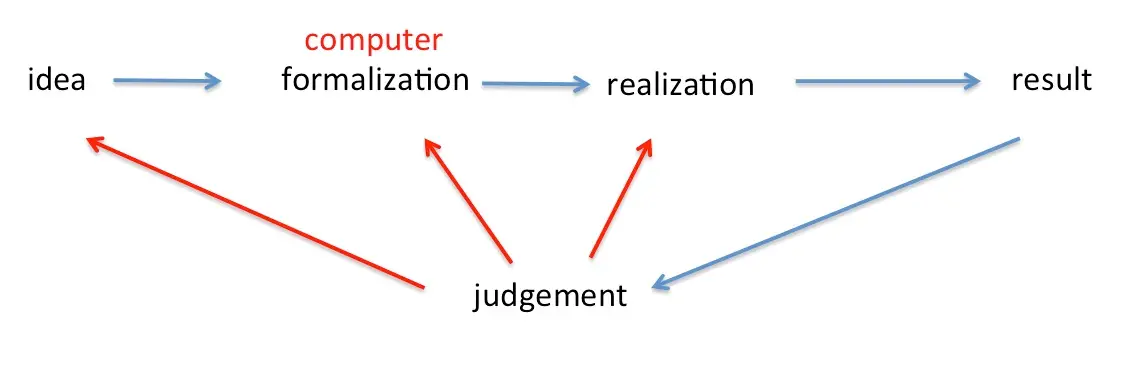
How can I make the idea understandable for the computer or the technology?
The result will again provoke a judgment that now points to the idea, the formalization and the realization. If the result is not satisfying, it’s now less clear where the problem lies: in the idea, it’s formalization or realization.
Another problem while using technology is a trend to not question the idea anymore. As soon as we get a result, we spend a lot of time to improve the formalization and implementation.
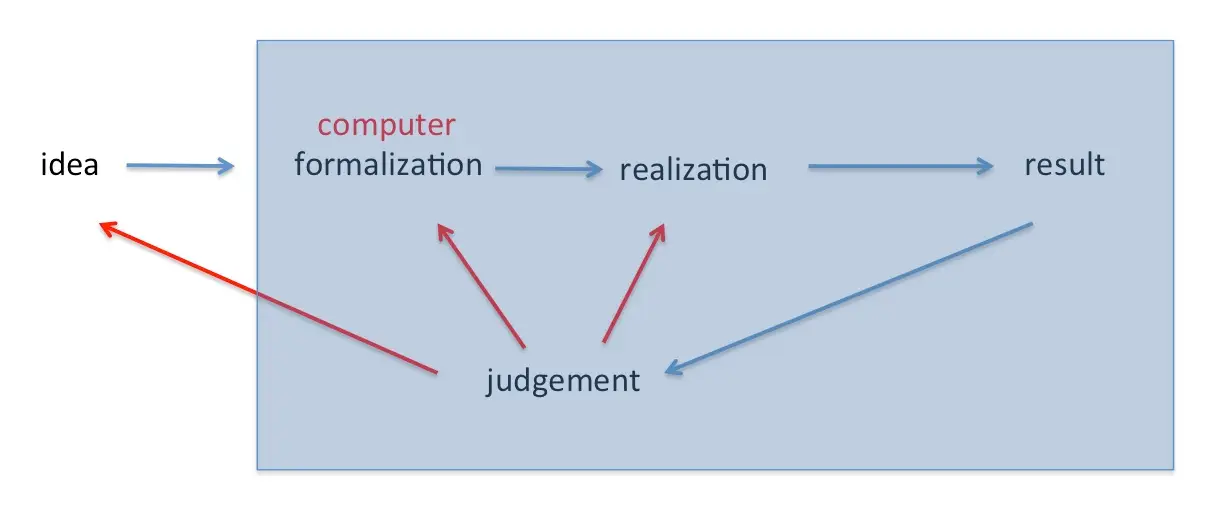
There is the risk that the judgment – as result of an obsession for the technology – forgets that the idea may also require questioning. I try therefore, to keep a certain distance to the magic of technology.
Ensemble für Intuitive Musik Weimar
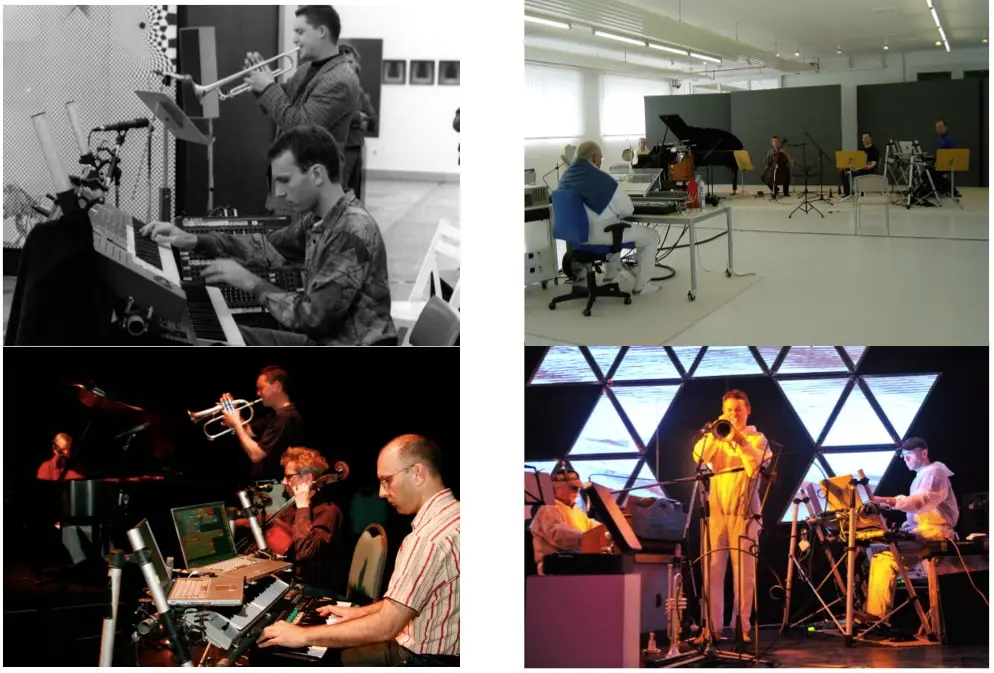
I joined the ensemble at the age of 15, and it became a place of incredible training. From the start, we worked on pieces by Stockhausen, Cage and other composers who were not represented in Weimar during the communist regime. Accompanying Stockhausen after 1989 on his concert tours, and working with many improvising musicians trained me and let me focus on an interesting question: what is an instrument?
Playing with a pianist, cellist, and trumpeter in the ensemble, I've realized that the question for them did not arise. Although with piano preparations one can expand the produced sounds, the instrument remains pretty much defined.
Jokingly, I sometimes say that a person would not learn the clarinet if he should be afraid that in six months there was an update that puts all keys to another position. A certain stability in the relationship with an instrument is important in order to develop reflexes.
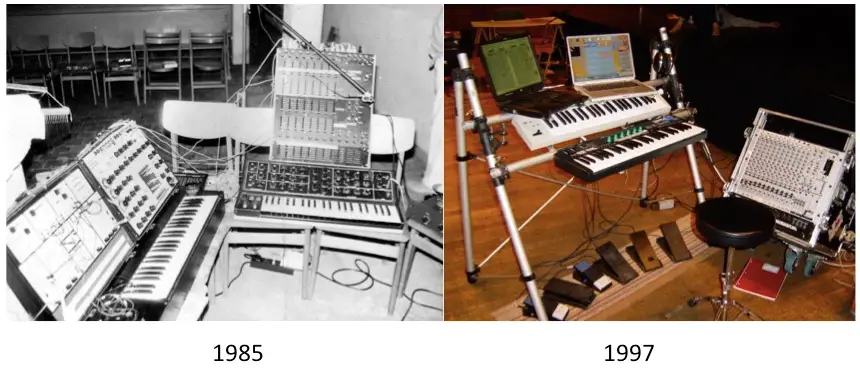
I worked for years to gradually increase the opportunities of my instrument and to refine it. But since 1997 its functionality has not changed. There are two keyboards, two computers, and a few pedals to control parameters.
These reflections are part of a technological change that I experienced during the past 30 years.
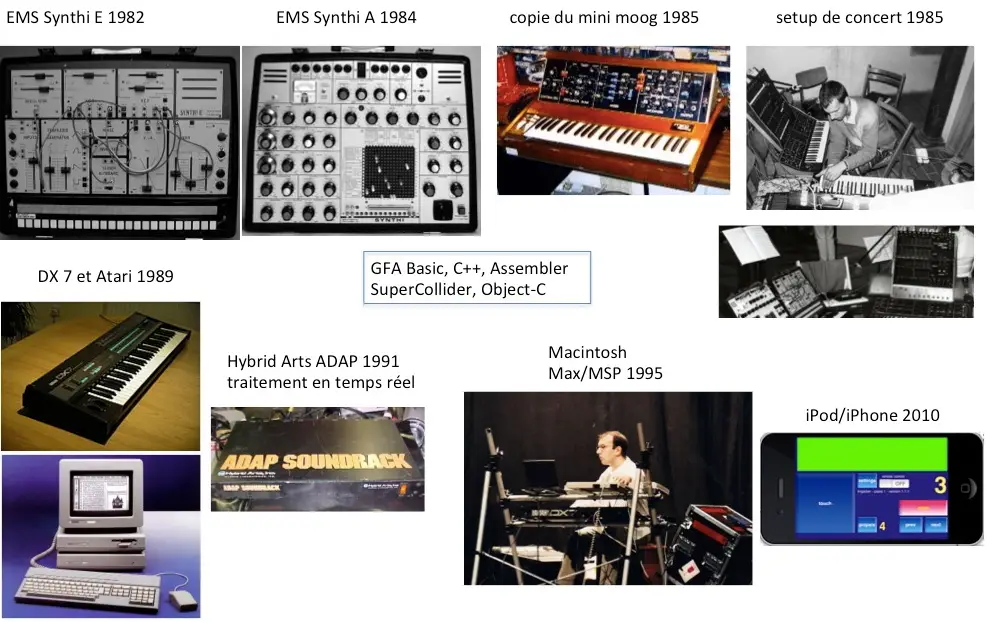
In 1982 I had my first analog synthesizer, the Synthi E by EMS. Later the Synthi A, its big brother. Eventually, someone got the construction plans of a Minimoog and copied it, because all these devices were not on sale in East Germany.
For my first electroacoustic composition, I cut the tape in cassettes, because I did not have a tape machine with reels.
I got my first computer and a DX7 as a gift from Markus Stockhausen, the trumpeter son of Karlheinz Stockhausen in 1989. Markus had come to Weimar almost every summer since 1982 to play with us.
Subsequently, I worked with different programming languages. In 1990/91 I studied ‘Sonology’ in The Hague in the Netherlands and followed a course on real-time sound treatment. I also followed a demonstration by IRCAM exploring their workstation with the NEXT cube and three DSP cards, which costs a fortune. I was thus eager to find an affordable solution for real-time sound manipulation.
Hybrid Arts had produced an expansion equipment for the ATARI computer with audio converters and Texas Instruments processors to turn the computer into a 16-bit sampler. But this product sold poorly. Onstage musicians prefer a keyboard with everything integrated, instead of bringing three boxes to be interconnected and a computer screen. They discontinued the product and sold it cheap, together with a programming manual.
I therefore learned C for the interface, Atari assembler for the communication with the converters and TMS Machine language to program the DSP processor from Texas Instruments.
At that time signals were not calculated as blocks (signal buffers), but each sample after another. I had 20 nanoseconds between two samples and could see how many arithmetic operations or memory access cycles I could fit into.
For one year I 'went deeper down to the heart of the machines than I could ever imagine. In 1991 I had finished a program that allowed simple granular synthesis, transpositions, delay lines, etc.
As I did not want to travel with that Atari tube screen, I had programmed it in a way to be able to leave it at home. At computer startup, the program loaded and specific keys were associated with treatments. For some visual feedback, I connected two LEDs, a red one for times of sound acquisition and a green one for any playback. The lesson learned: without watching a screen I listened differently. My communication with the other musicians was not absorbed by visual feedback.
Since 1995, MaxMSP became my main platform and I was very careful thereafter, as how to interact with the software during the concert and to limit the need for visual interaction.
The last few years I have also experimented with iOS devices and will talk about it at the end of this presentation.
Learning the analog synthesizer served me well. The Synthi A was a modular synth with a connection matrix. The modules were not connected by default, and the audio and control signal flow could be determined by freely interconnecting outputs and inputs of modules.
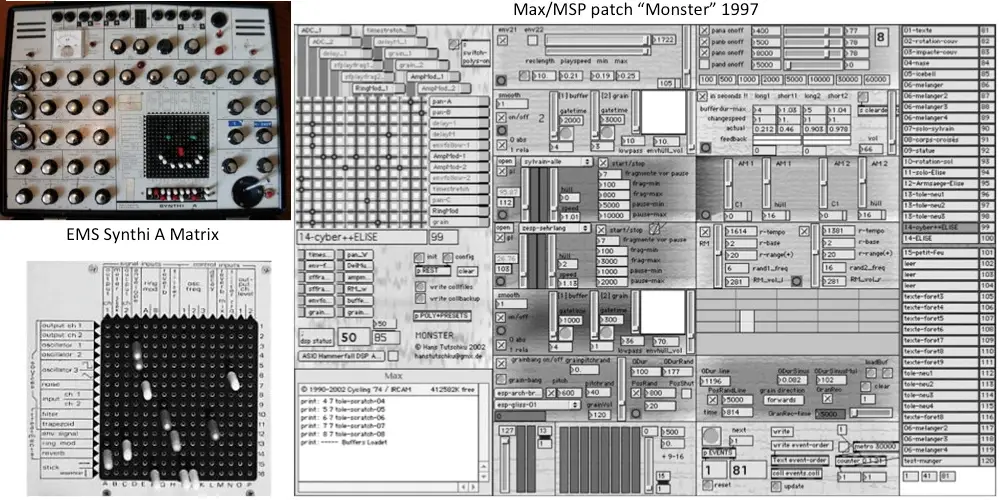
One could simultaneously use the microphone signal to control parameters. I explored this possibility a lot in order to link the evolution of parameters to the intensity of the incoming sound.
My first improvisation patch with MaxMSP in 1997 was called 'monster', which I’m still using. It underwent updates to MaxMSP 3,4,5,6,7, but the idea has not changed. The patch is also organized in modules and contains a matrix. It has also signal analysis modules to use the microphone for parameter control.
Gesture
The physical gesture of instrumentalists and dancers was of great interest to me over the past 30 years. My music education on the piano, and later with live-electronics taught me to perform music, long before I started composing. Therefore, gesture is central to my musical thoughts: the act of making is inseparable from the sound quality.
All the music I wrote, whether for instruments, singers, or electronic sources, is in search of the expression of gestural phrasing, the relationship between cause and effect (and its negation) and a plausibility, informed by our experiences outside of music.
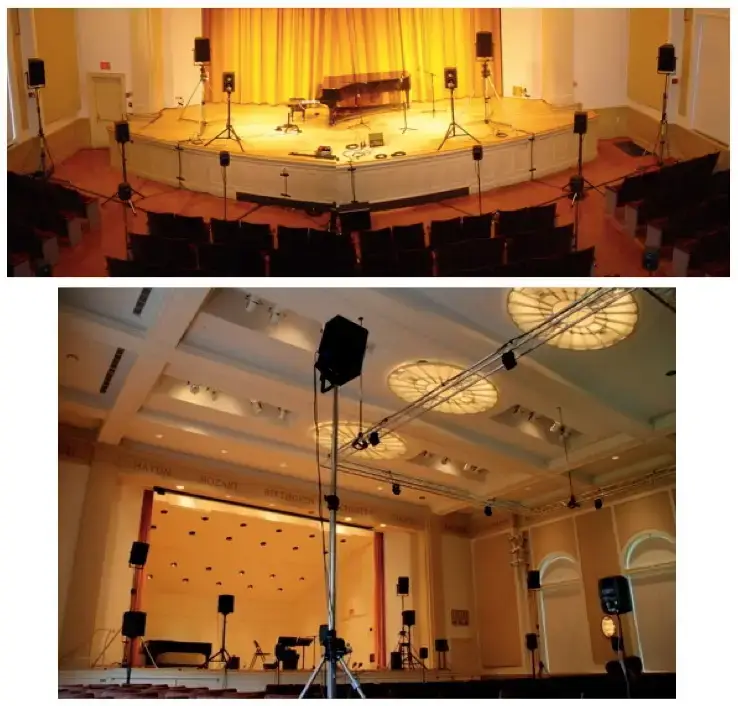
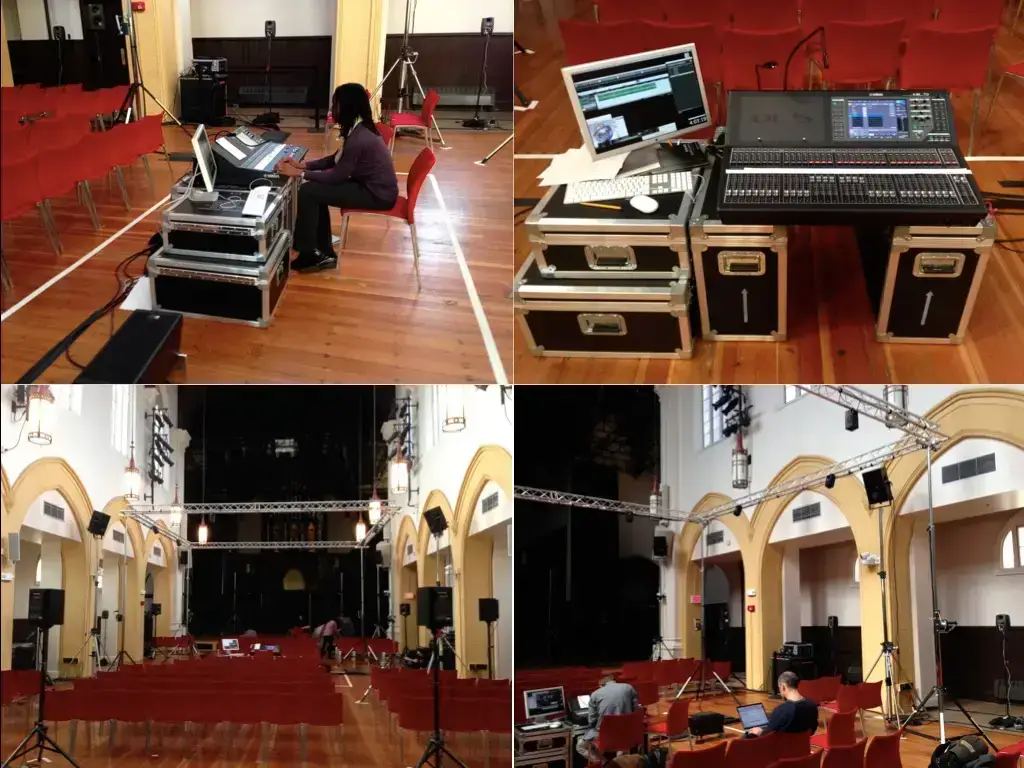
The gesture is also important in my spatial thinking, both in composition and in the interpretation of works on loudspeaker systems. Here are some pictures of Harvard’s diffusion system ‘Hydra’ with 40 speakers.
Das Bleierne Klavier / Zellen-Linien
I’ll speak now of a piece for piano and electronics from 1999. The idea was to create a prepared piano without physical preparations in the instrument and the possibility that the preparations change, sometimes quickly.
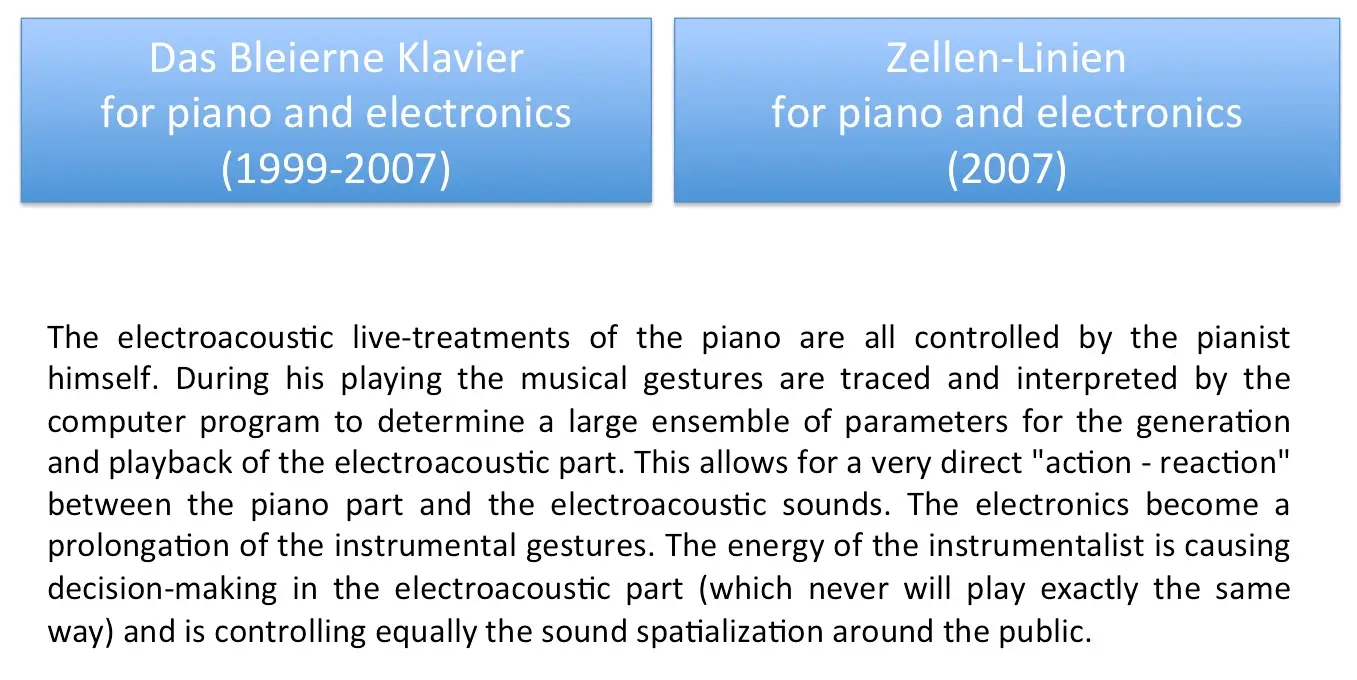
For ‘Das Bleierne Klavier’, there was not a written score but verbal descriptions for the relationship between instrument and electronics in each of the 32 sections.
That gave me a lot of freedom to explore new ideas during each concert and over time they converged to a model. Each new interpretation followed the models general lines, but with local explorations. Several pianists asked me to be able to play the work. I rehearsed with a few, but I did not get exactly what I wanted as their knowledge of the interaction between the two media was naturally limited
and could not inform their improvisations.
Therefore, in 2007 I wrote a version that was very close to my ideal model.
But, once the material existed on paper, I saw temporal relationships in a different dimension. While improvising, I had a different view of the proportions. I began therefore to reconstruct some aspects and the written version ‘Zellen-Linien’ emerged.
Let's look at some techniques to recover the gesture of the performer. The first phrase that I experimented with is based on the ‘F5’. I wanted to add to each ‘F5’ on the piano a different recording of a ‘F5’ prepared piano sound. There is also a note of ‘B5’ in this musical line, which should not double with a pre-recorded sound. The computer thus needed to distinguish between the two different pitches.
I spent a lot of time to search for a pitch tracking solution, but without success. The sound of a piano note is very noisy during the attack. I could have delayed the analysis by 30 ms to concentrate more on the harmonic portion of the note, but in that case the decision about its pitch, and subsequently the playback of the prepared sound would also have been delayed.
So I found myself in this loop where I was no longer questioned the idea.
Once I realized this, I changed for another approach: musicians have the incredibly fine ability to control dynamics of their playing. I could just write the phrase for the piano to play the notes of ‘F’ with a dynamic ‘mf’ and the note ‘B’ with a dynamic ‘piano’. I was thus developing an envelope follower.
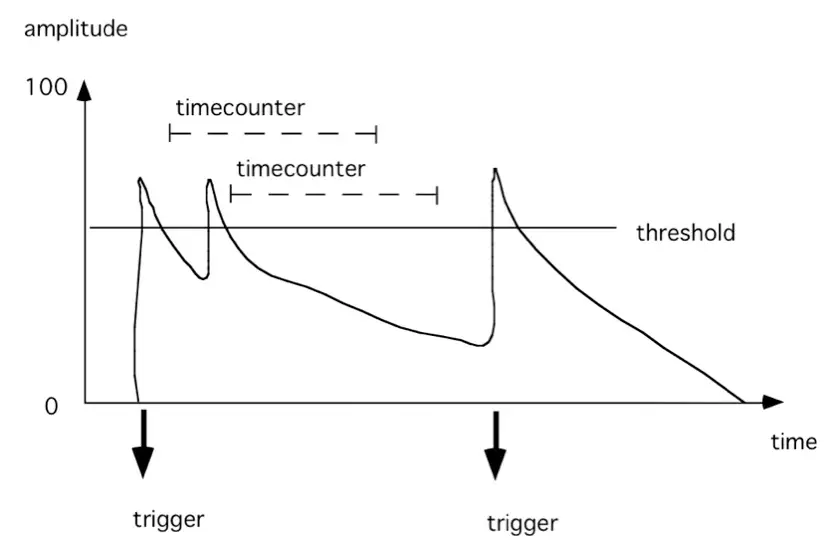
As soon as the signal exceeds a threshold, the follower detects it. I can connect, among other possibilities, the playback of a sound file to this action. In the case of this phrase I actually connect it to a collection of sounds: each new moment of attack will trigger a different prepared sound.
The envelope follower has a second parameter: the time that the signal must remain below the threshold for the next attack to be considered. This could help to avoid double attacks, but can also serve as a compositional parameter. In a very dense texture for example, only the notes are taken, which were preceded by a moment of silence.
I’m playing you the sound example of this phrase.
This is the beginning of the score. The work starts with a few chords in the bass that trigger sound files by the same envelope follower. It gives the impression of a real-time processing, but the sounds are prepared files, synthesis results with the Diphone software.
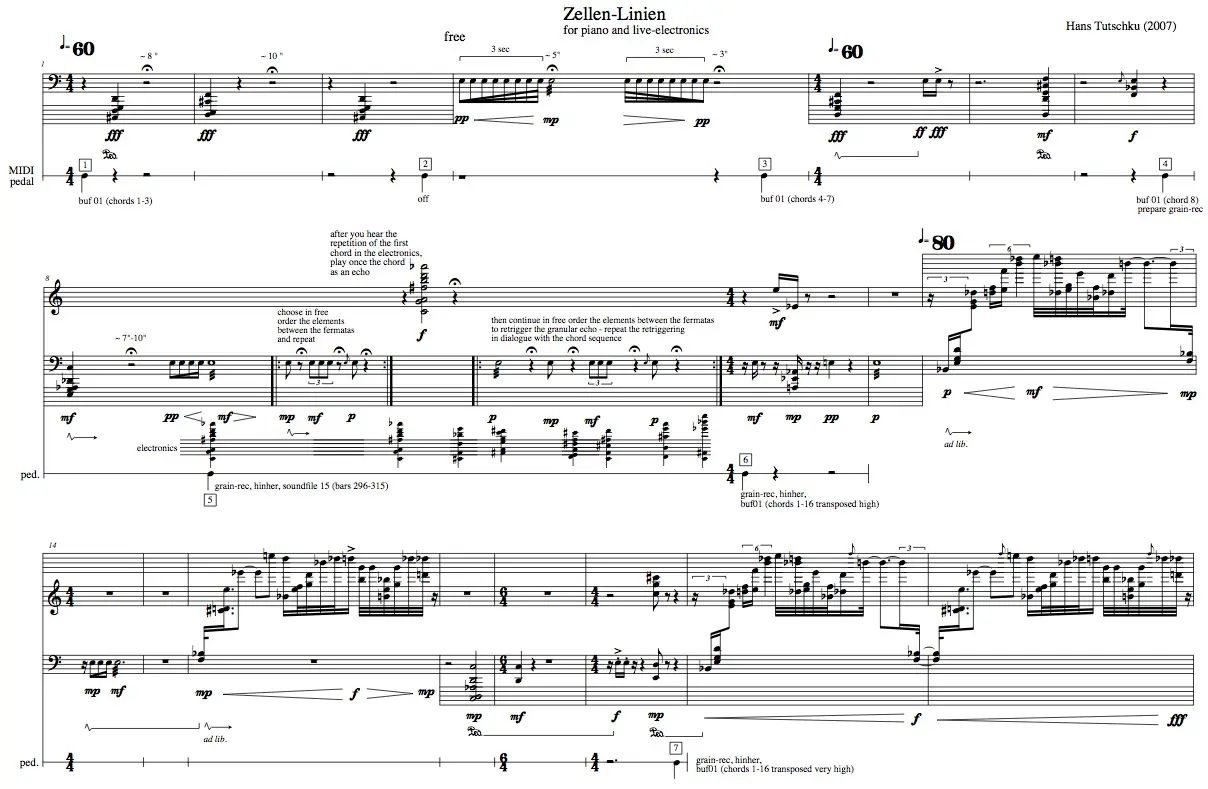
In the second system, you see a chord progression in the electronics. After the second repetition of the first chord, the pianist will play the same chord, like an echo of the electronics. This is something that interests me a lot.
If we look at compositions for instruments and tape from the 50th, 60th, 70th we see that they have often a complex temporal relationships between the instrument and the electronics. Once the real-time processing became accessible, we often observe a sort of temporal impasse, where the electronics are only happening at the same moment as the instrument – e.g. for transposition - or later. I tried therefore a combination of pre-recorded sounds and real-time processing to obtain a multidimensional time network, where electronics can also introduce musical material.
I play you the beginning of the composition in a recording with Sebastian Berweck:
At the end of the piece, it’s the pianist who will play the sequence of chords. I use the amplitude follower to trigger a ‘freeze’ mechanism, which records a short moment of the chords spectrum that is maintained thereafter. This sound is doubled with a granular synthesis, which also is controlled by the intensity of the played chords.

I now turn to some other examples for my use of gesture. In 2005, I wrote the chamber opera "Die Süsse unserer traurigen Kindheit" on poems and letters of expressionist Georg Trakl.
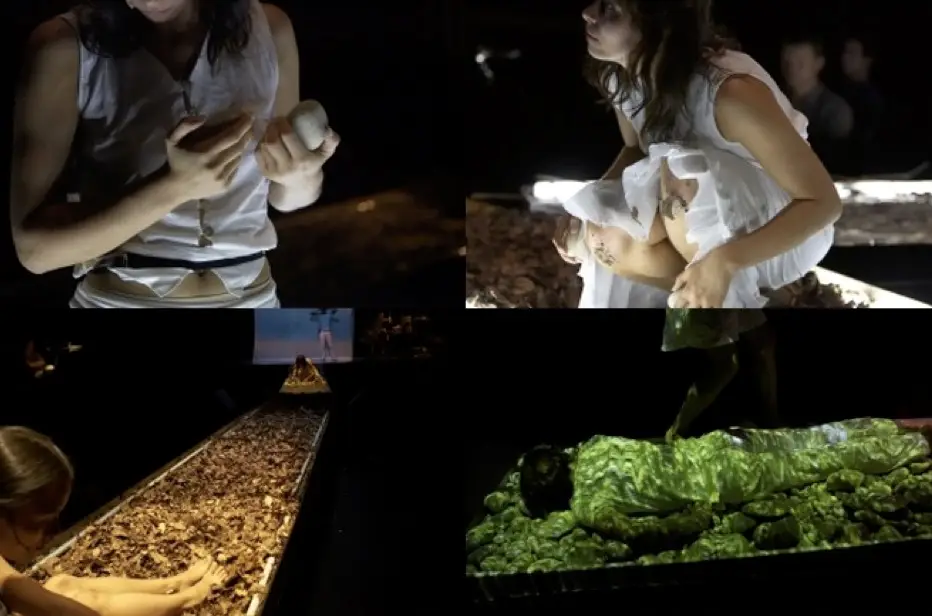
Apart from two sopranos, five instruments, electronics in 16 channels and 4 video projections, there is also a dancer.
In the 1990s, I worked with dancers and we also experimented with motion sensors. But, the results did not convince me. It is not because I can technically trace movements of arms and legs that I obtain a guarantee for a gestural link. For me there is a difference between an instrumental gesture, which is functional and the gesture of a dancer which is expressive in itself. The movements to play a musical instrument are not beautiful, but they are related to the operation of the instrument. In contrast, the gesture of a dancer is originating in the center of the body and does not follow a function. To request from a dancer to produce gestures to trigger sound events or to control parameters did not satisfy me. I used therefore a wireless microphone near his mouth to catch his breath, naturally connected with his actions. The dancer had no added mental gymnastics to perform, he could just express himself as usual. It was very interesting as the breath also gives us information about the quality of the preparation of a movement.
In this chamber opera, there is a solo dance, and the singers are silent. All electronic sounds are generated and controlled by the breath of the dancer. During the sequence I am looking for a changing relationship. There are moments where the link is very clear. But I don’t want it to become too obvious, otherwise it becomes a demonstration of technology. ‘Integration’ and ‘confusion’ are very active thought models here and I use variations in the way how the microphone effects the electronics over time.
The dance solo with Hans Georg Lenhart:
The gesture in my sound recordings
I will now give some examples of gesture in sound recordings for my electroacoustic works. I’m no longer interested in recording a single sound. I develop musical phrases with the sounding body in question. It starts with an exploration of the possibilities, and soon I develop phrases that I try to realize as precise as I can.
A pianist interpreting a written score develops a mental image of a given phrase and compares it to what he is actually playing. He repeats the phrase during his rehearsals to approach that image - and sometimes - changes the mental image to improve the musical result. I try to get into this rehearsal loop and make several realizations of the idea until I approach what I had envisioned.
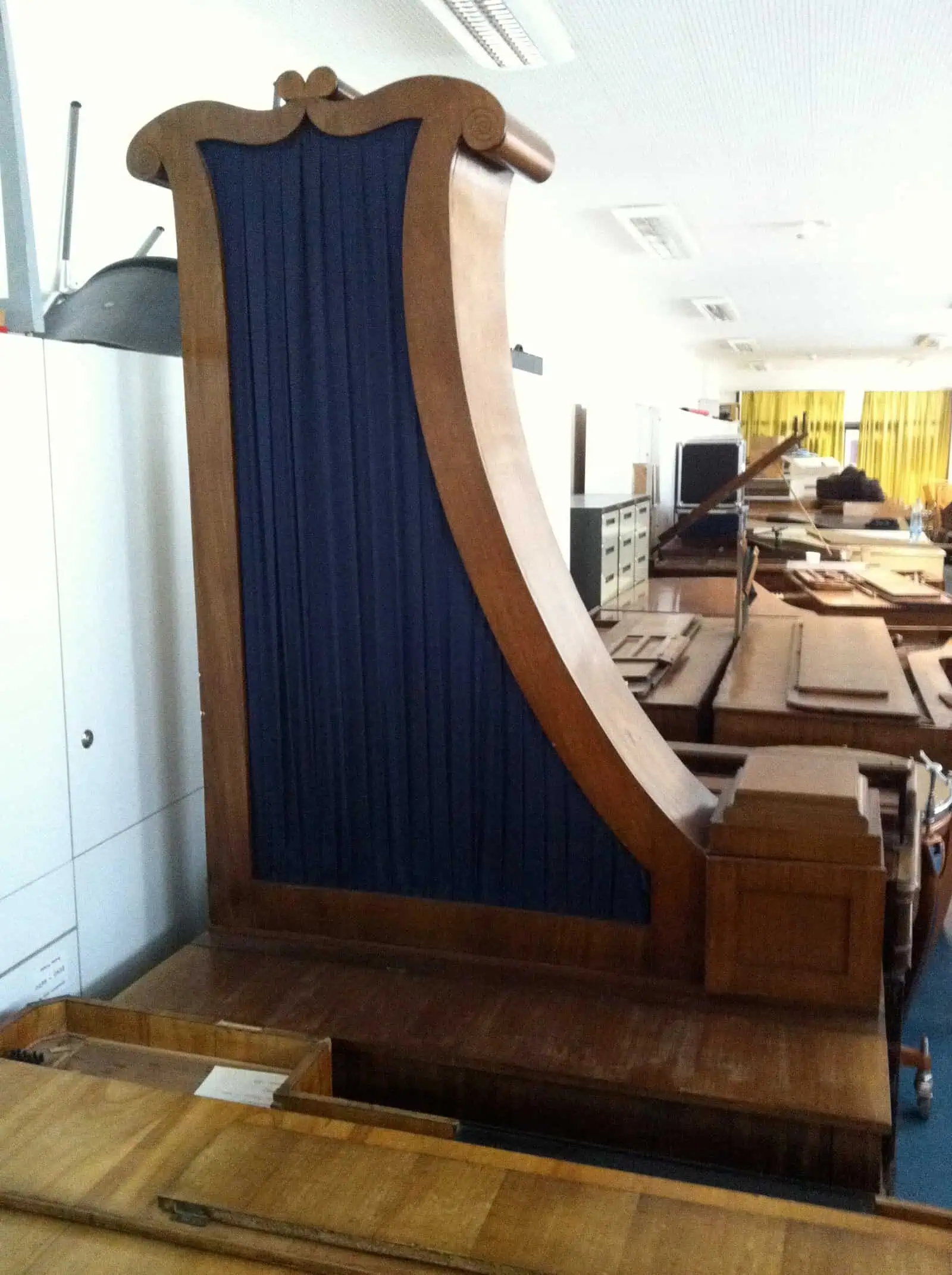
‘Klaviersammlung’, an electroacoustic composition you'll hear at tonight’s concert, is based on the sounds of a piano collection from the Musicology Department at the University of Cologne. They are all in a deplorable state. I have recorded five instruments, especially playing inside, sometimes using glasses on the strings.
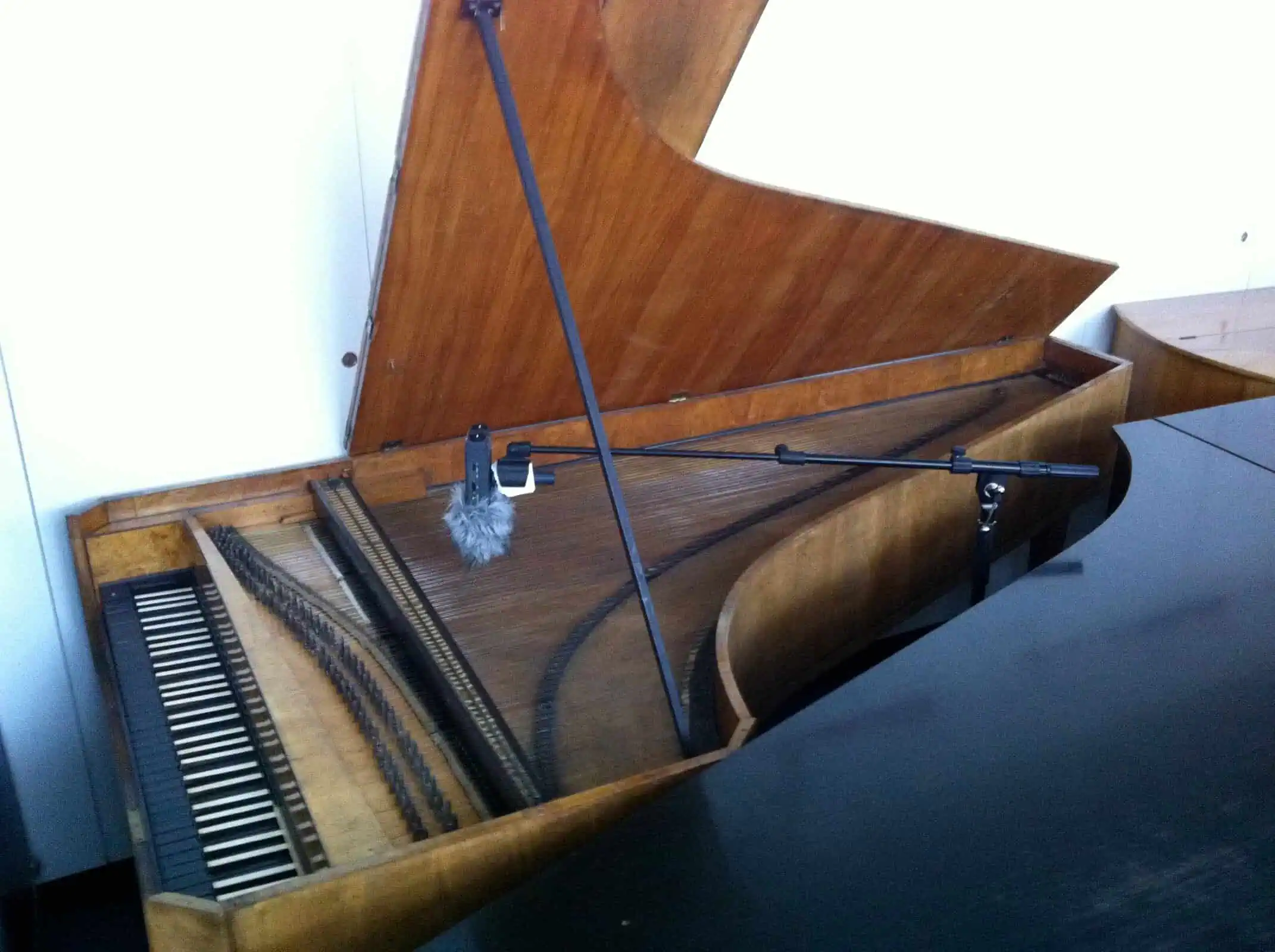
This particular piano is interesting because the ‘unused’ part of the string between the peg and the bridge is very long, compared with a modern piano where it is short and very tense. Here, this part of the string sounds a lot, but with a completely different tuning.
This video shows one of those sound recordings:
The following four sounds demonstrate some of my approaches with these playing sequences. These are the original recordings, without any treatment.
Circular scratch:
Rhythmic structure:
Densification: a rattling bass string:
The following sequence has become the theme of the composition. It is a glissando and with each repetition during recording I choose different pitches on the last notes.
The idea of variation is very dear to me. One advantage of the way to record my playing sequences is that I get naturally many variations of the same musical idea. If I want to repeat the same sound structure in the composition, I choose another recording, instead of reusing the same sample. Sometimes I directly use them as temporal evolution. Sometimes I mix them for complex textures, where all components follow the same general evolution.
Other art forms
I now turn to some examples in other art forms, in which I could explore the relationship with technology. They are not isolated from my musical practice because everything is interconnected. I see the work in these different fields as separate realizations of the same artistic sensibility.

Here, you see a painting of oil on glass that I realized in 1984. By putting a strong light source behind, I get pictures with great contrasts.
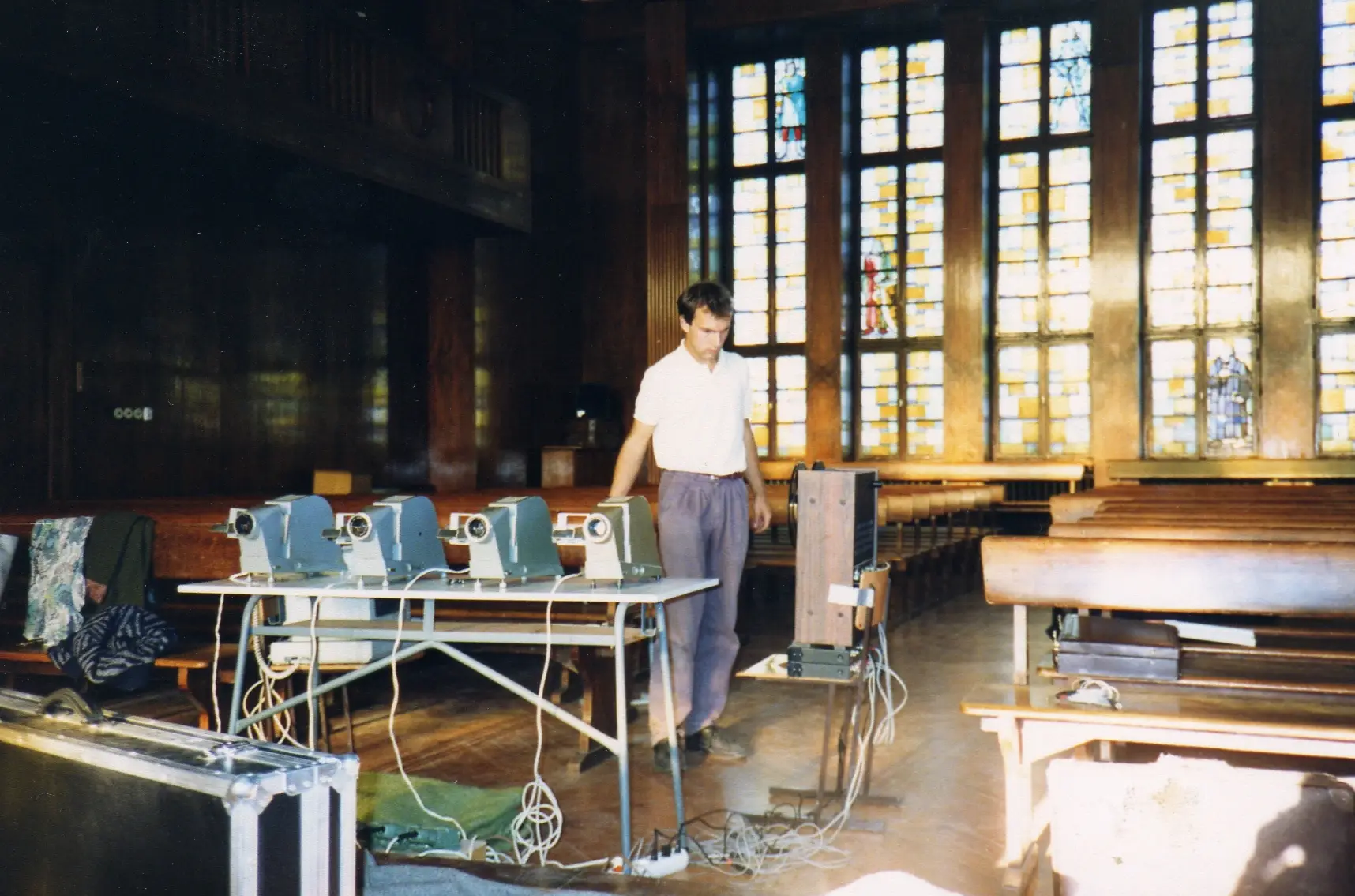
I built a system of four slide projectors, superimposing their images, with intensity sliders to play them manually. In the comings and goings of the images, this created an abstract space in slow modulation, projected onto a dancer on stage.
We played the piece ‘Klang-Farbe-Bewegung’ for dance, ensemble, and projection often in Europe. The structure is based on scenes and stories with a certain freedom of improvisation for slide transitions, movements, and music.
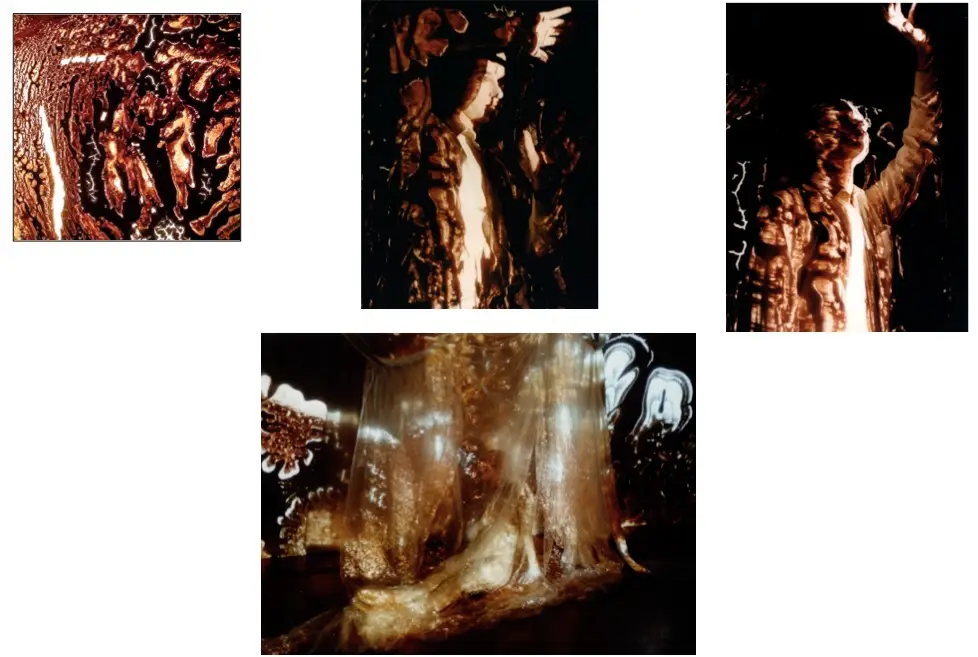
In 2009 I created a new version, where the projection is now realized with six videos.
Polyvision, for dance, ensemble and video (2009)
Dance - Hans Georg Lenhart
Ensemble für Intuitive Musik Weimar
Trumpet - Daniel Hoffmann
Violoncello - Matthias von Hintzenstern
Piano - Michael von Hintzenstern
Electronics - Hans Tutschku
During a rehearsal in the 1990th, I began to take photographs of the dancer in the projection. The result was a new expressive mode with frozen time. These photos became communication-objects with the public in further works.
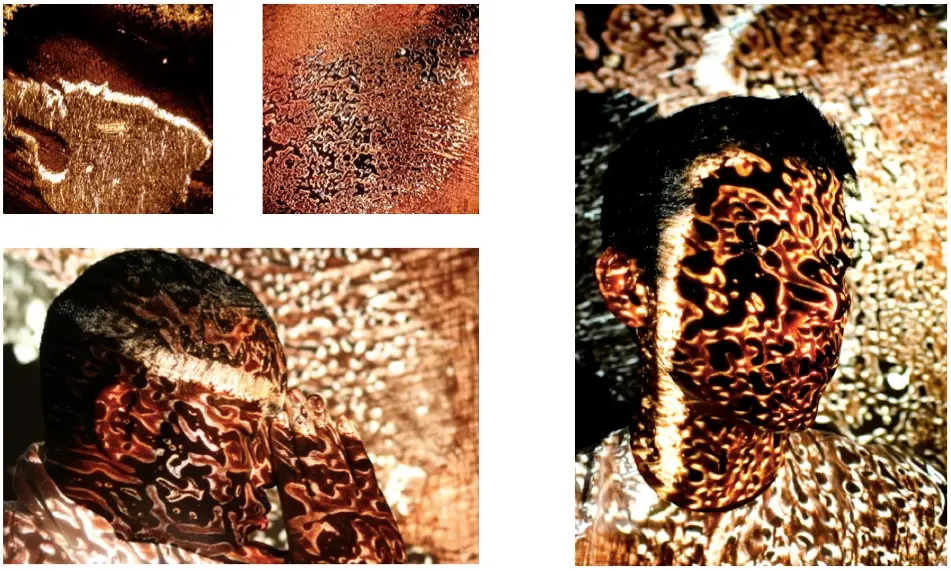
In 2007 I transformed them into interactive sound installations, where the photos themselves become speakers by sticking transducers on their back. Each installation has an integrated microphone.
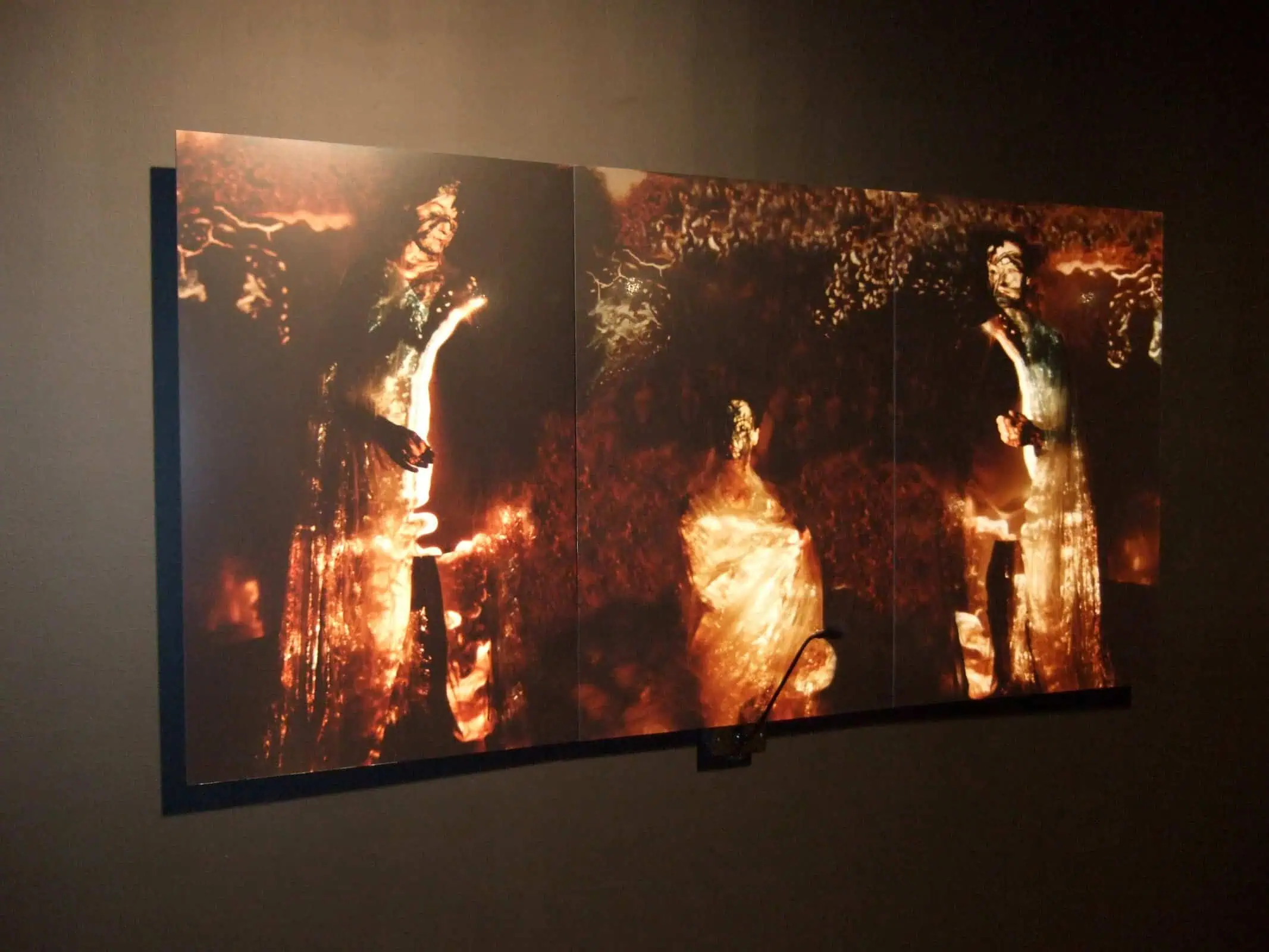
The visitor is invited to speak, sing, etc., and hears his voice transformed and blended with pre-composed sounds. There are a total of eight of these objects, each offering a different relationship between the action and the transformed voice sounds. In contrast to concert pieces I was looking for personalized experiences for each visitor.
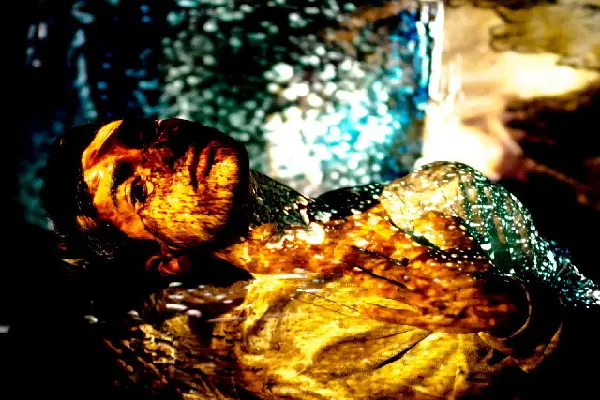
In 2013 I realized a new series of photos with dance students at Harvard.
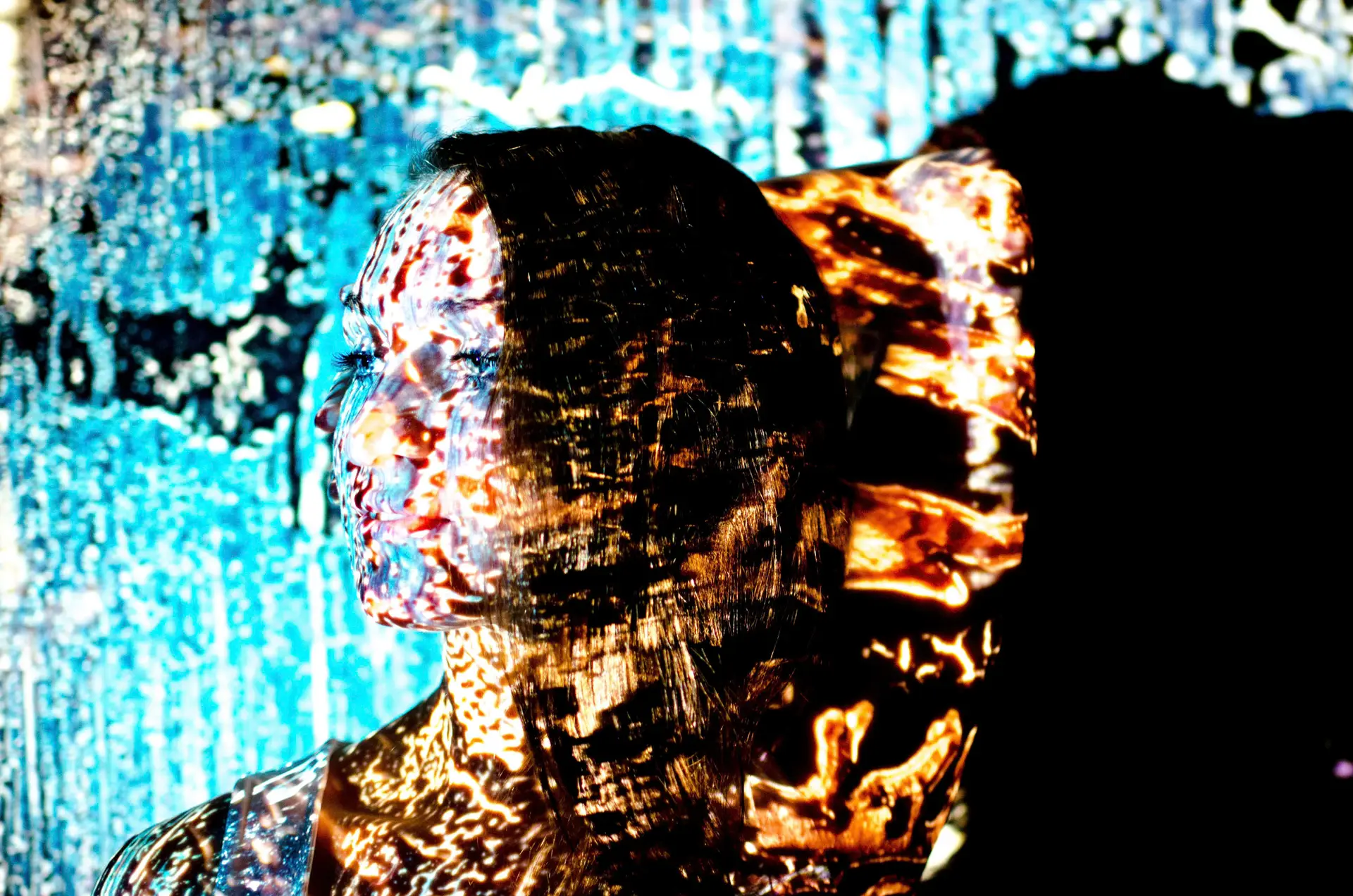
There is no digital processing like ‘Photoshop’, all images are simply the projection of my paintings onto the body.
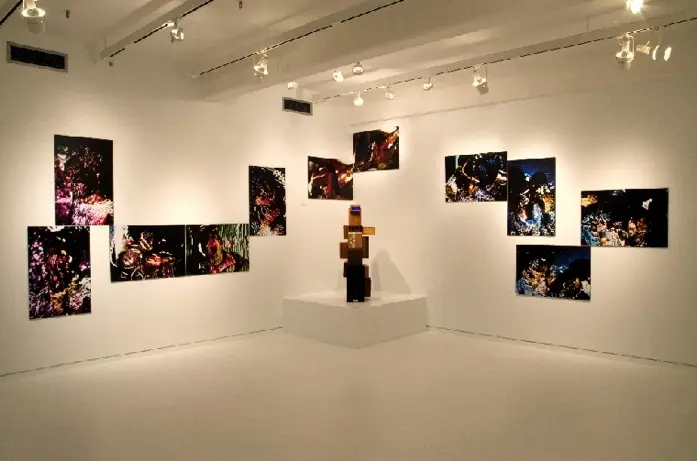
For the exhibition ‘The other side’ (2014), the photos were grouped into spaced arrangements and combined with two interactive sound sculptures.
The piece of art as an interface - interactive sound sculptures
These sculptures are continuing my research for a personalization of the relationship between the visitor and an expressive object.
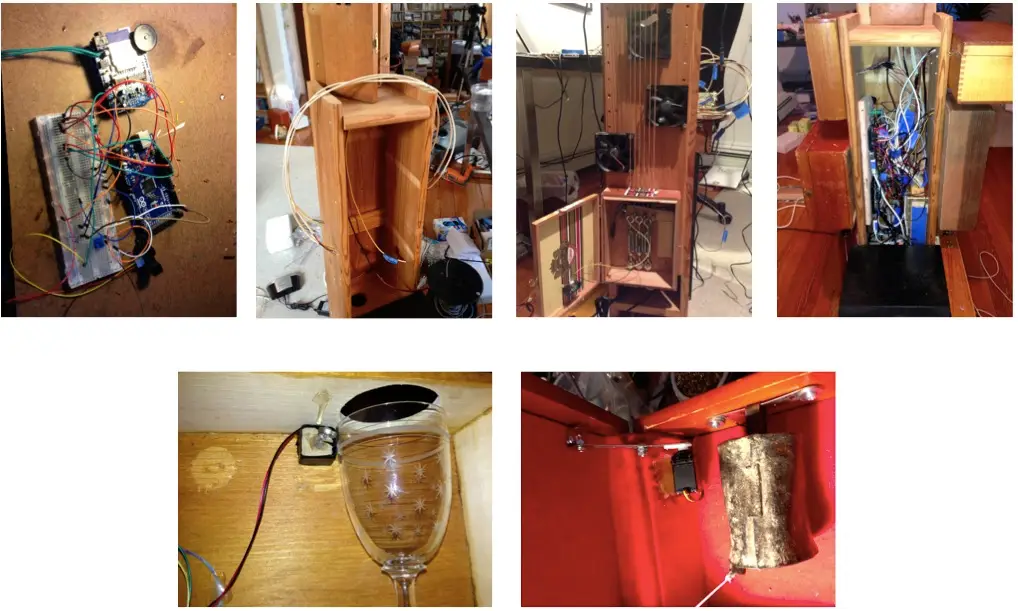
‘Hommage à Schwitters’ is rooted in DADA, uses Kurt Schwitters’ ‘Ursonate’ and reacts with different acoustic and mechanical effects depending on the presence of a person around the sculpture.
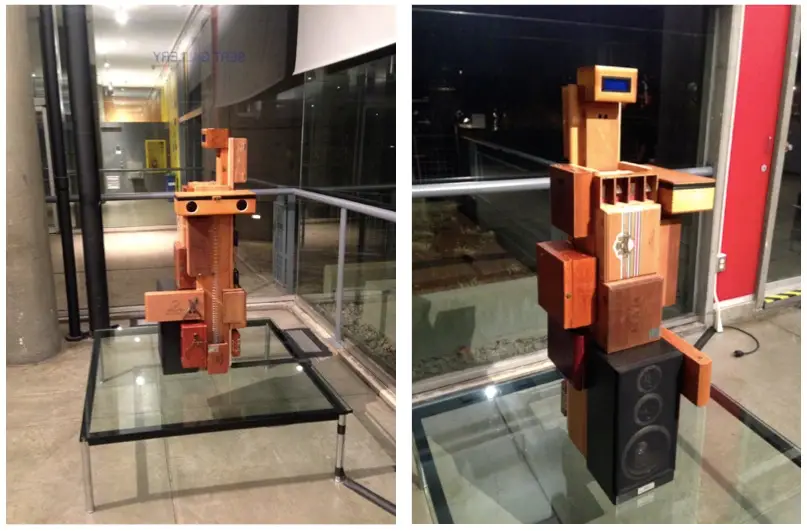
It is a blend of Arduino processors, sensors, motors, etc.
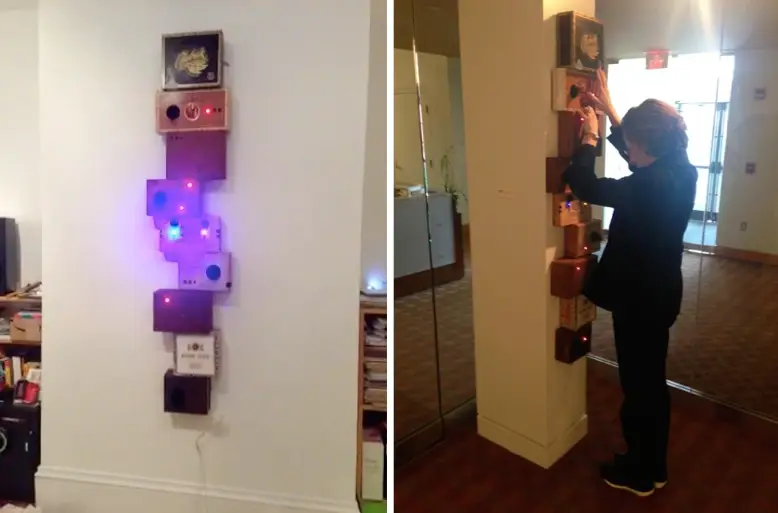
The sculpture ‘Collaboration’ is even closer to the idea of an instrument. The visitor is invited to activate up to eight voices with his hands or body. He can choose from 16 sets of sound ensembles.
I will now speak of a project that had its origin here in Montreal in 2009. It started as a two-hour sound installation for the church Gesù.
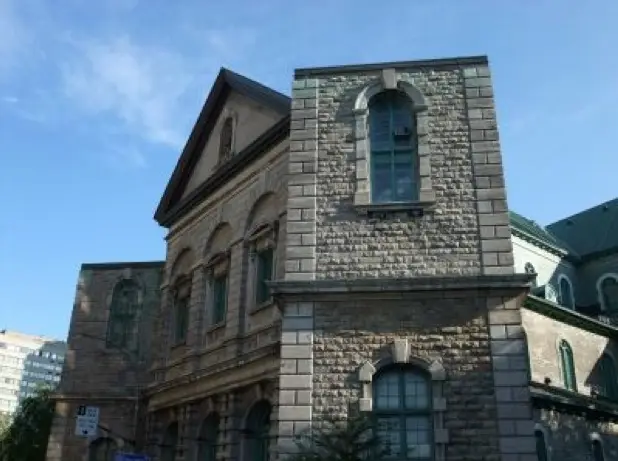
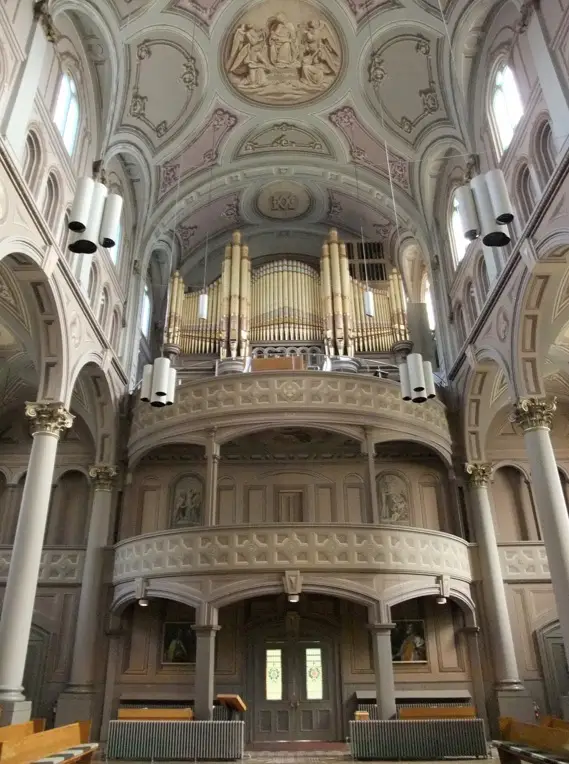
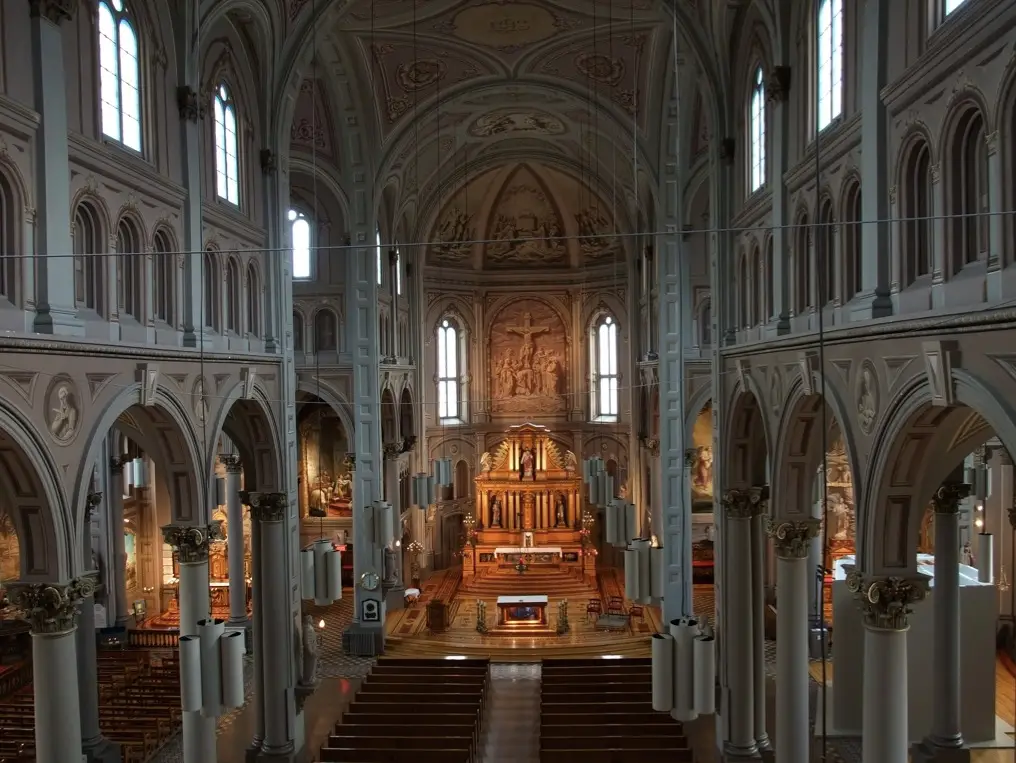
With its ample space and a reverberation of 7 seconds, the church suggested a very different piece than my usual electroacoustic works.
The human voice is present in most of my compositions for more than 25 years. Sitting in this church on my first visit in 2008, I imagined 200 singers of many ethnicities and religions celebrating together – while surrounding the audience. The installation was subsequently presented in the cities of Erfurt and Cologne in Germany, but I was now looking for a way to introduce the idea of an utopian ritual also as a concert piece.
In 2014, I realized ‘Issho ni’, which is partially based on excerpts of the sound installation, but recomposes material, adds new voices and seeks a more controlled temporal evolution. For a concert piece I can imagine the audience experience more specifically than for an installation where spectators move in and out. The piece surrounds and overwhelms the listener who becomes a witness and passive participant in a slow illusory celebration. Elements from secular and religious sources join to commemorate unity and joy.
All sound sources were recorded individually: voice, bells, flutes, organ, percussion, and sound objects.
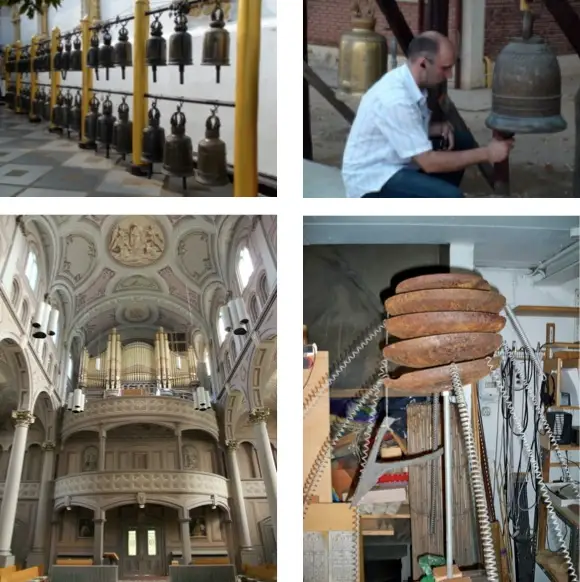
With ‘Melodyne’ I altered the pitches of the notes to harmonize songs from different cultures and to make them join my own harmonic development.
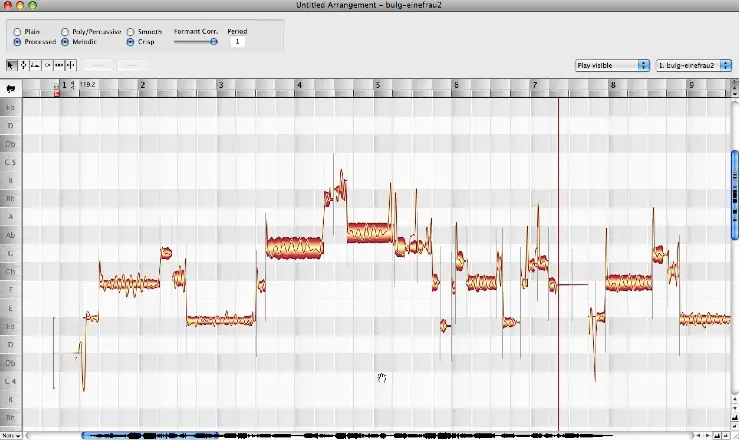
Original voice of Bulgaria:
Transposed on one of my chords:
Combined with an organ recording from the church Gesù:
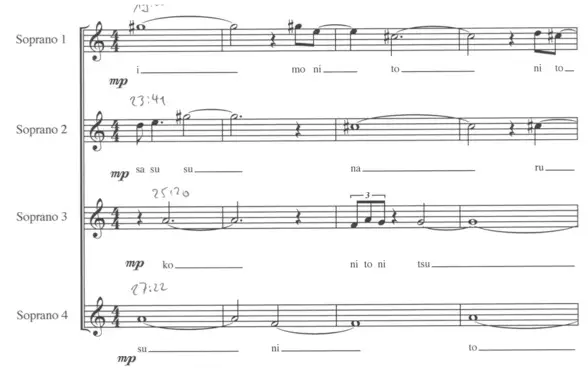
I also composed four-voice counterpoints, which were recorded in the studio with soprano Jennifer Ashe:
Their combination with traditional voices:
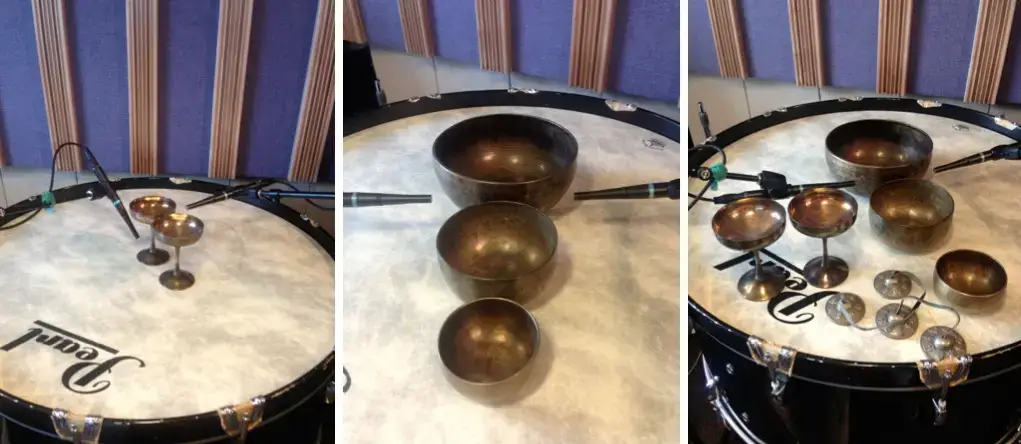
Two examples of percussion sound recordings. I placed Tibetan bowls onto the skin of a bass drum:
Their combination with voices from Korea:
To give you an impression of the musical texture, I’ll play a four-minute excerpt of the composition. Obviously, such a project would be impossible without the existence of the technology itself, but also demands its integration into the process of design and production of the work.
iOS
My final chapter today will talk about some ideas on the use of small devices.
Since 2010, I have composed works for instruments / voices and iOS devices. I am interested in their portability, speedy setup, and the possibility that musicians can easily rehearse with the electronics.
The integration of electronic components in the rehearsal process of mixed music remains a difficulty. Many interpreters are not equipped with microphones, sound cards, and suitable computers to work with the electronics in the study of their parts. They rely on the expertise and technology of a sound specialist. These resources are often only available a few rehearsals before concerts, sometimes only on the concert day in the hall. This situation does not give enough time for musicians to integrate the electronic component into their interpretation.
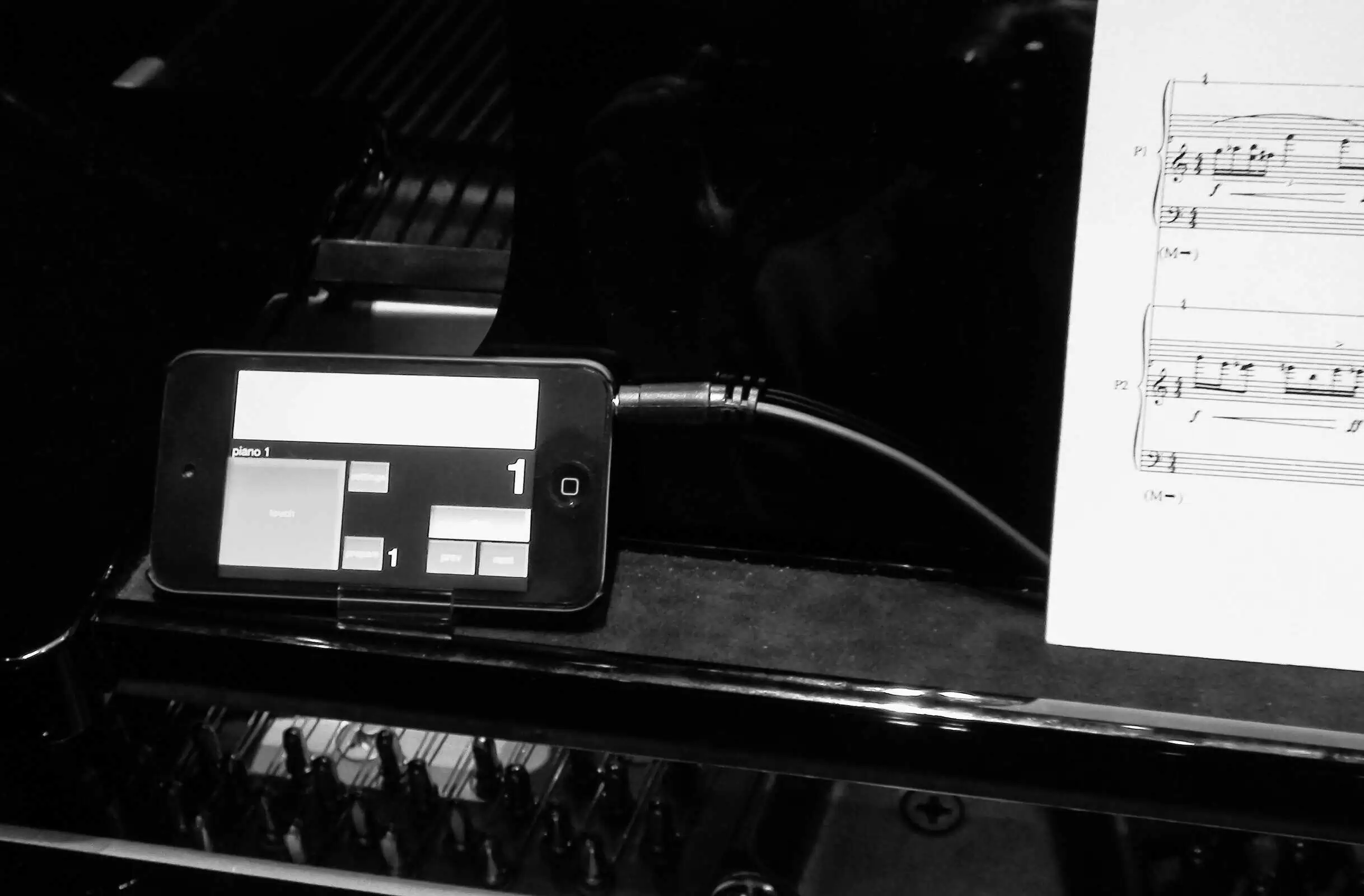
I do not use iOS devices to remotely control a computer; they contain all the electronics. Only the iOS device and small speakers are needed. This helps to integrate the electronics from the beginning of their rehearsals and makes installation easy.
There are of course many compositional limits. The real-time processing of instruments is not an option as the quality of the built-in microphones is not good enough.
So far, a series of composition has been realized with some other works in progress.
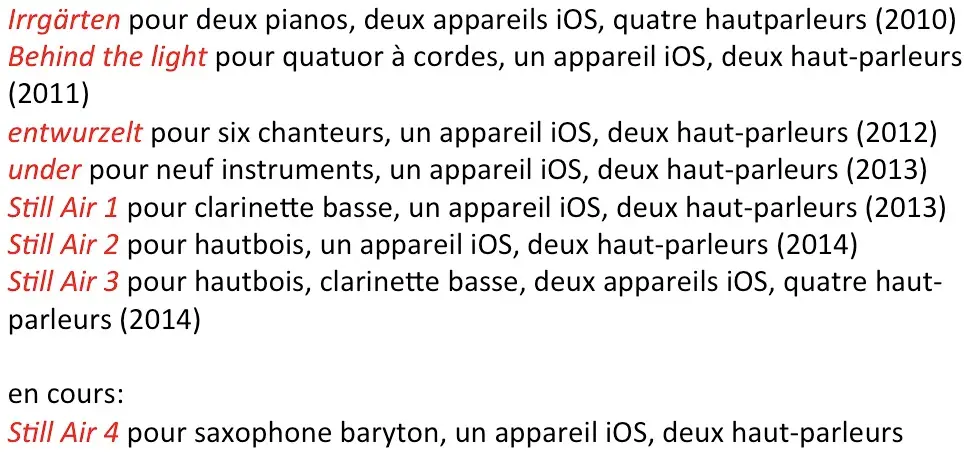
In ‘Irrgärten’, each pianist has its own setup with an iOS device and two loudspeakers placed inside the piano, facing the lid. This allows for a balanced mix between acoustic and electronic sounds.
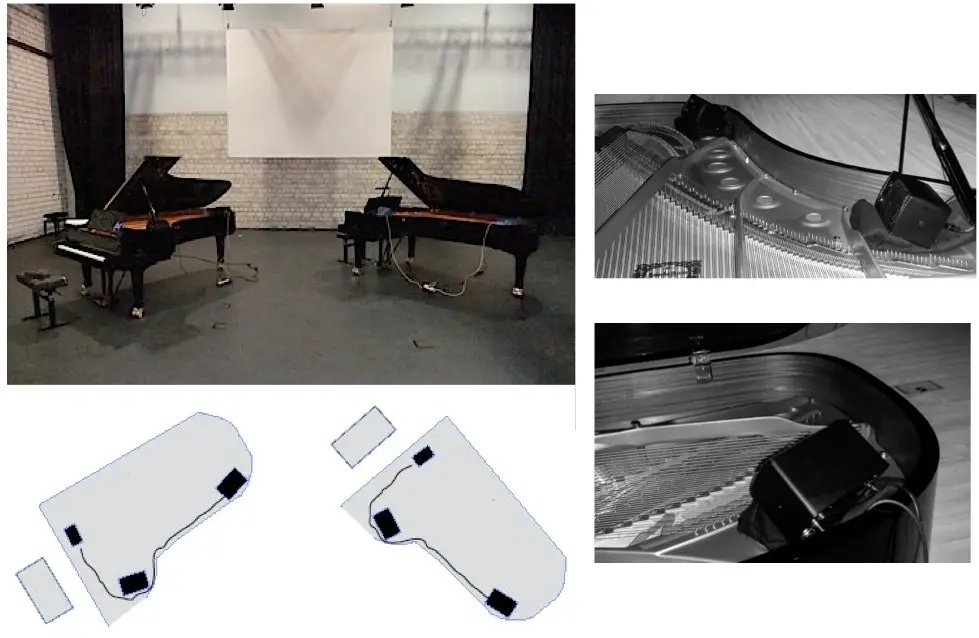
The internal microphone is used with an amplitude follower to detect notes of the instrument and thus synchronize the electronic part with prerecorded sound files.
Here is a short excerpt of this work with Jennifer Hymer and Bernhard Fograscher:
The two pieces ‘Entwurzelt’ and ‘under’ use the iOS device as a sampler, where a musician triggers sequences of prepared sound files at the indicated moments in the score.
I’m currently exploring a third relationship between instruments and the iOS device in the ‘Still Air’ cycle.
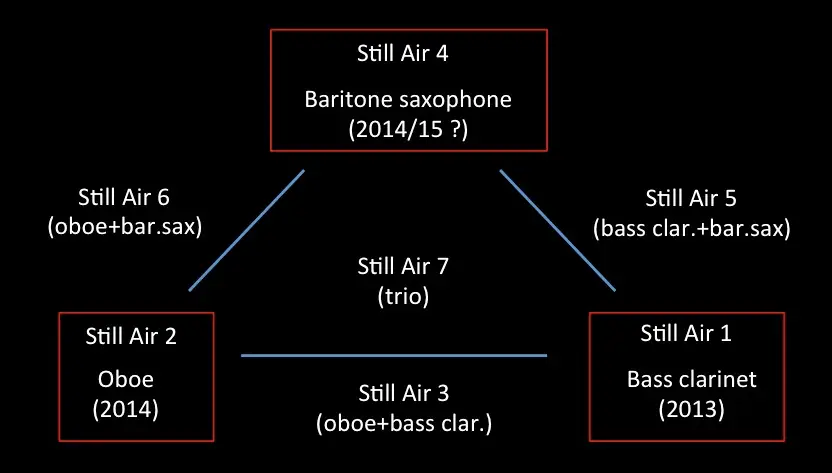
Once completed, the cycle will consist of three solo works and all possible combinations between them.
Still Air 1 - bass clarinet
Still Air 2 - oboe
Still Air 3 - bass clarinet + oboe
Still Air 4 - baritone saxophone
Still Air 5 - baritone saxophone + bass clarinet
Still Air 6 - oboe + baritone saxophone
Still Air 7 - bass clarinet + oboe + baritone saxophone
Each instrument has its own installation again, with the device close to the instrument and two speakers behind the musician.
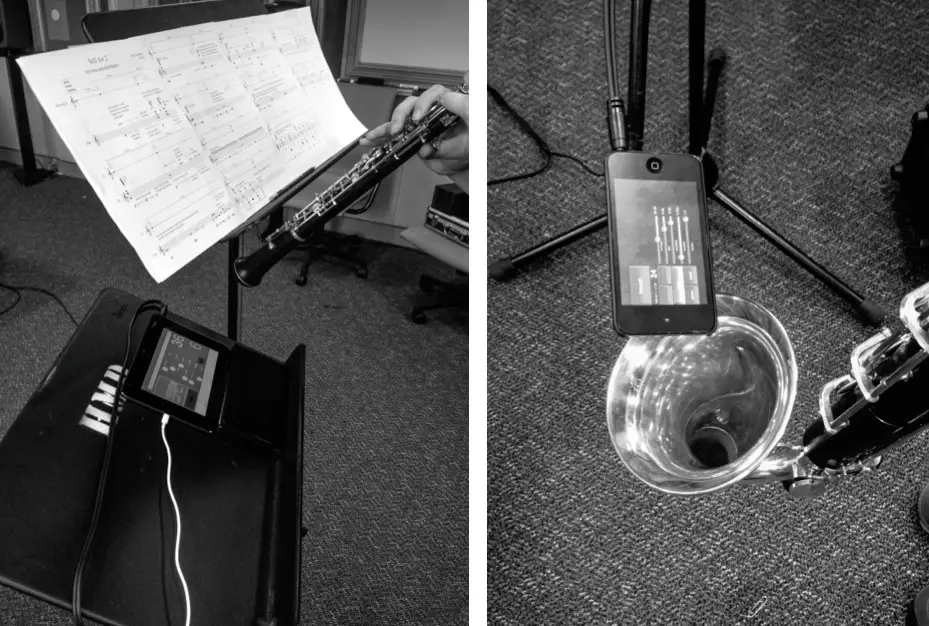
The integrated microphone is used this time to trace the overall energy of the instrument. The electronic component is composed of two layers.
Layer 1 is like a tape, independent of the instrumentalist.
Layer 2 modulates the amplitude (and slightly the pitch) of the sound files by following the amplitude of the instrument. This layer therefore becomes a gestural extension of the instrument.
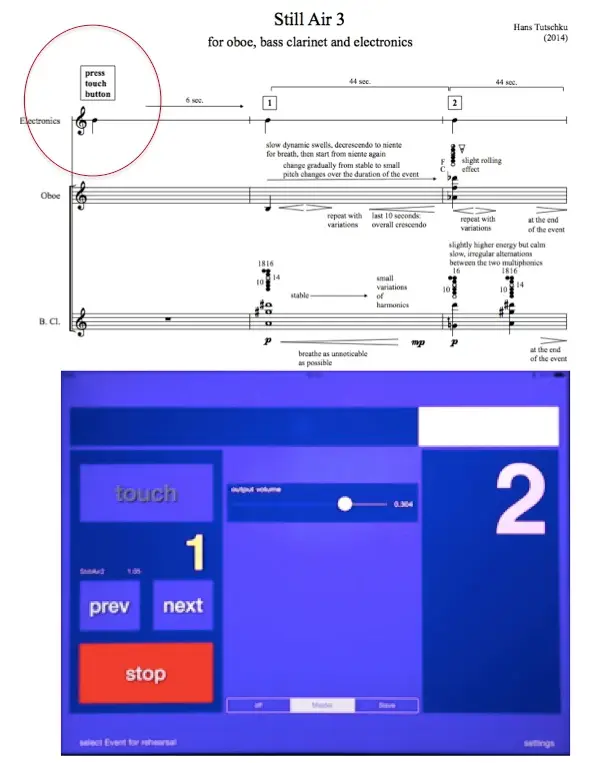
The musician touches the start button at the beginning and thereafter synchronizes with visual information from the device.
Here is an excerpt of the first performance with Arthur Sato - oboe and Alejandro Acierto - bass clarinet.
To conclude, I’m going back 30 years to a concert in 1985 in the church of Gelmeroda, a village five kilometers from Weimar.
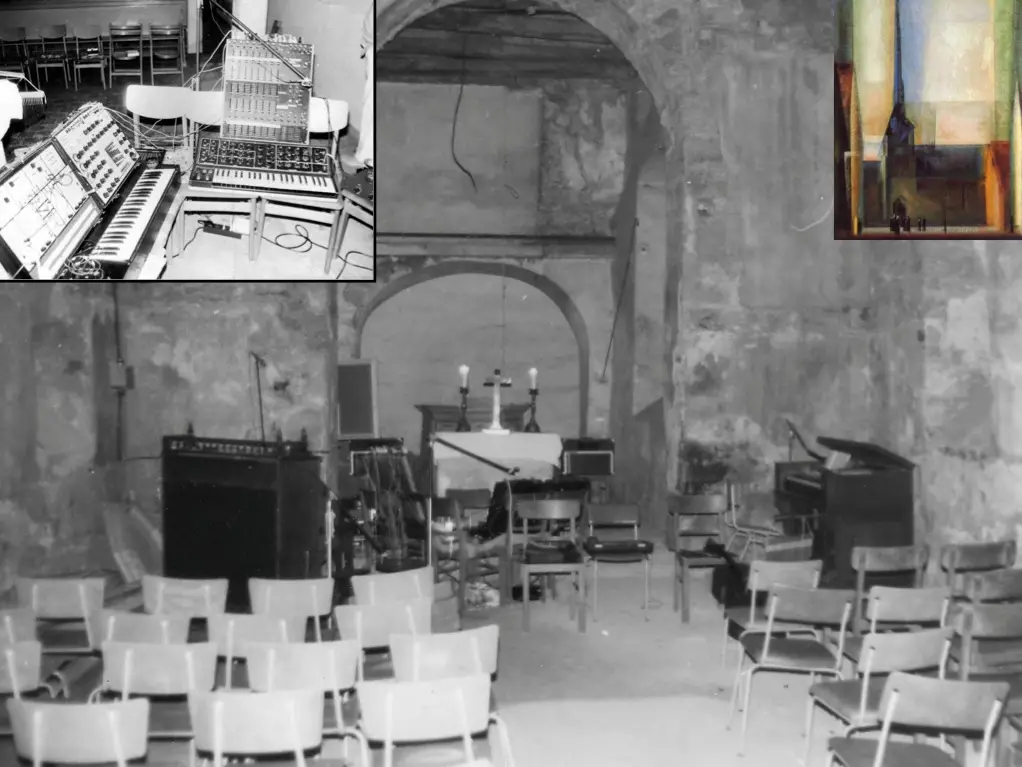
The church is known worldwide as Lyonel Feininger painted it more than 30 times. This concert remains etched in my memory for two reasons: I can trace my interest in the integration of technology as an instrument to that time already, but there was another aspect of this concert which made it special. On the program were several compositions of Karlheinz Stockhausen.
Half an hour before the beginning, a lady of about 90 years came and sat in the front row. With a too common prejudice, I thought she had mistaken the concert. Then, we began to play and I had forgotten about her. After the concert it was this lady who came to me and said, "Thank you for this experience. Now, I can die in peace." I was shocked and did not understand. She added: "Now I can get an idea how the music will sound in the next century." She turned and went out.
What a lesson to not underestimate our audience.
There is another phrase, which is very dear to me: "Art changes the world - one person at a time."
Thank you