Klänge des Augenblicks - Review by Torsten Möller – 04 May 2025
Embracing the World with Intuitive Music
The documentary about the Ensemble for Intuitive Music Weimar presents a slice of the history of contemporary music in the GDR and of the ensemble’s relationship with Karlheinz Stockhausen. The International Composition Competition of the Künstlerhaus Boswil also plays a significant role.
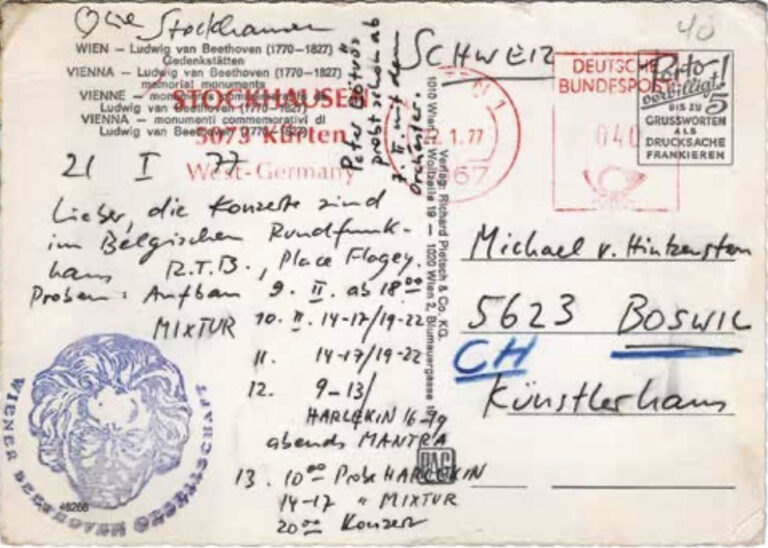
Stories written by life itself: Thanks to a prize at the International Composition Competition in Boswil, Michael von Hintzenstern was able to undertake his first journey to the West from the GDR in 1976. He not only made use of the three-month work-and-study residency in rural Switzerland that came with the award, but—without the East-German authorities’ permission—also changed his itinerary: he set off for Cologne to visit the revered “master,” Karlheinz Stockhausen. Stockhausen’s concept of “intuitive music” would shape both Hintzenstern and his Ensemble für intuitive Musik Weimar (EFIM)—and, ultimately, the richly illustrated and engaging book Sounds of the Moment, which reproduces several handwritten documents from their correspondence.
At the heart of the book is the story of the ensemble founded in 1980 and built around four restless, experimentally minded musicians: Michael von Hintzenstern on organ and assorted synthesizers; Hans Tutschku, the specialist for electro-acoustic and electronic sound; Daniel Hoffmann, the “jazzer,” on horn and trumpet; and Matthias von Hintzenstern, usually on cello but also active with sound installations.
In the early years, works by Stockhausen dominated the programmes, such as the fifteen text compositions for intuitive music Aus den sieben Tagen (1968) and the well-known Tierkreis (1974/75). Over time—spurred on by the fall of the Berlin Wall in 1989—the repertoire broadened. Tutschku increasingly contributed his experience with French electro-acoustic music, and EFIM sought venues far from traditional concert halls, performing in parks, botanical gardens, and potash mines 670 metres underground. The ensemble could now accept concert and workshop invitations in thirty countries on four continents.
Anyone passionate about experimental music will be enthralled by this documentation. But it is equally worth reading for those interested in the cultural history of the GDR. Music, in particular, offered genuine spaces of freedom—spaces that EFIM used in an astonishingly open, intelligent, and warmly outward-looking way.